
Cognitive Tutor, published by Carnegie Learning, is a math curricula that combines textbooks and interactive software.
Clearinghouse and Evidence Level
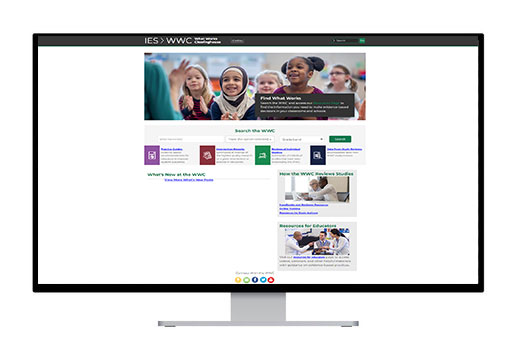
What Works Clearinghouse
The What Works Clearinghouse (WWC) is an investment of the Institute of Education Sciences (IES) within the U.S. Department of Education that was established in 2002. The work of the WWC is managed by a team of staff at IES and conducted under a set of contracts held by several leading firms with expertise in education, research methodology, and the dissemination of education research, including Abt Associates, American Institutes for Research, Development Services Group, Inc., and Mathematica. Each WWC contract focuses on furthering the goals of the WWC. Information about active WWC contract work can be found on the “WWC Content Teams” page. Visit the “What We Do” section of the WWC website to learn more about the type of work happening at the WWC.
Level 3
Quick Stats
Content Focus Area
Curriculum, Instruction, and Assessment
Grade Band
Middle School; High School
Number of studies
6
Intervention Information
The information below provides details and characteristics of the intervention. The presented information is sourced from another clearinghouse. To learn more about the intervention, click through to the Source clearinghouse.
This page displays information on the population and settings in which studies were conducted on the intervention’s effectiveness. This means that the intervention has some level of positive evidence in the listed student populations and context. Remember to take your school’s context and population into consideration when selecting an intervention. Read more on selecting interventions.
| Resource Type | Program Evaluation | This presents the grade level of students represented in the reviewed studies for this intervention. On the OEBC, grade bands are categorized into four levels: Early Childhood (Birth-Age 5), Elementary School (Grades K-5), Middle School (Grades 6-8), and High School (Grades 9-12). |
|---|---|---|
| Subject Area | Math | This refers to the school subjects: English Language Arts, Math, Science, and Social Studies. An intervention will be tagged with a subject if a reviewed study by the source clearinghouse has found that the intervention led to positive results in learning in that subject. |
| Setting |
|
This presents the setting represented in the reviewed studies for this intervention. On the OEBC, setting has three categories: Rural, Urban, and Suburban. |
| Demographic |
| Demographic information refers to the student’s race/ethnicity and gender. It also includes information on subpopulations (e.g. Students with Disabilities, English Learners, Economically Disadvantaged, Justice Involved, and Foster Care). On the OEBC, an intervention is only tagged with demographic information if that intervention is specifically designed for, and has been reviewed on, that demographic. Please click through to the source clearinghouse to find total demographic breakdowns of all students who have taken part in a study on the intervention. |
| Training Needed | Listed | This indicates if the source clearinghouse has information on training needed to implement the intervention. | Length of Program or Delivery | Listed | This indicates if the source clearinghouse has information on how long the intervention takes to implement (e.g. session delivery time and/or how many days or weeks it takes to implement). |
| Cost | Not Listed | This indicates if the source clearinghouse has information on the cost to implement the intervention. |
| Effect Size | Listed | This indicates if the source clearinghouse provides an effect size for the intervention. Please visit the source clearinghouse to find the effect size and read more about the studies on this intervention. |
Studies Cited
- Cabalo, J. V., Jaciw, A., & Vu, M. T. (2007). Comparative effectiveness of Carnegie Learning’s Cognitive Tutor Algebra I curriculum: A report of a randomized experiment in the Maui School District. Palo Alto, CA: Empirical Education, Inc.
- Ritter, S., Kulikowich, J., Lei, P., McGuire, C., & Morgan, P. (2007). What evidence matters? A randomized field trial of Cognitive Tutor® Algebra I. In T. Hirashima, H. U. Hoppe, & S. Shwu-Ching Young (Eds.), Supporting learning flow through integrative technologies (pp. 13–20). Netherlands: IOS Press.
- Campuzano, L., Dynarski, M., Agodini, R., & Rall, K. (2009). Effectiveness of reading and mathematics software products: Findings from two student cohorts (NCEE 2009-4041). Washington, DC: U.S. Department of Education, Institute of Education Sciences. http://files.eric.ed.gov/fulltext/ED504657.pdf.
- Pane, J. F., Griffin, B. A., McCaffrey, D. F., & Karam, R. (2014). Effectiveness of Cognitive Tutor Algebra I at scale (high school experiment). Educational Evaluation and Policy Analysis, 36(2), 127–144. doi:10.3102/0162373713507480.
- Shneyderman, A. (2001). Evaluation of the Cognitive Tutor Algebra I program (Unpublished manuscript). Miami, FL: Miami–Dade County Public Schools, Office of Evaluation and Research.
- Wolfson, M., Koedinger, K., Ritter, S., & McGuire, C. (2008). Cognitive Tutor Algebra I: Evaluation of results (19931994). Pittsburgh, PA: Carnegie Learning, Inc.